A load line is the mark that says how much a hull can safely carry. It's a working boat's number, and it's the right name for these: tenders designed specifically for yachting, not leisure runabouts sold to yacht owners.
Night watch, Charlotte Amalie
The brief
Four boats, one hull philosophy
A 14-foot open tender, a 19 open, a 19 console and a 21 — same 5 mm 5083 plate, same double-plated keel, same structural tow points. We run them in our own charter fleet eight months a year, in salt, with strangers at the helm. Everything below is what we found a boat has to be.
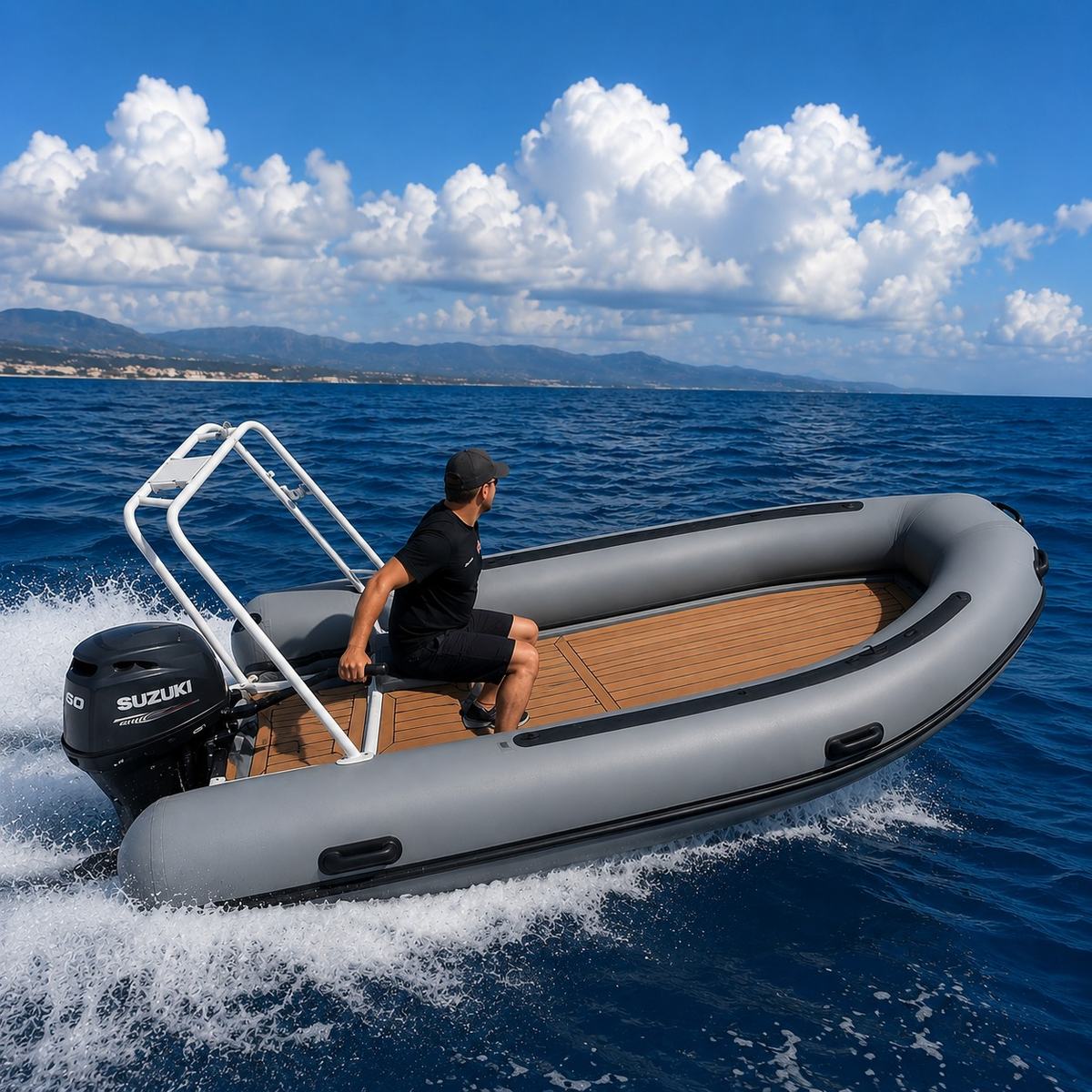
4.2 m open tender · tiller · Suzuki DF60A high thrust
$32,500rigged & commissioned
The smallest boat we build, and the only one in the range that answers the davit question with a yes. 240 kg dry. Hang a DF60A on it and you are at roughly 345 kg rigged — inside the rating of most production catamaran davits, and a long way inside a passerelle crane. Everything else we make has to be towed. This one has a choice.
It is a full Load Line hull, not a scaled-down one: 5083 plate, double-plated keel, real teak deck bow to transom, self-bailing cockpit, structural tow points fore and aft. Open, tiller-steered, seven aboard. No console to walk around when you are loading provisions or handing dive tanks up a swim platform.
The engine is a high-thrust DF60A — bigger gearcase, lower gear ratio, a large-diameter prop turning slowly. It gives up top end for something a yacht actually needs: thrust at nearly zero boat speed. Lash the 14 alongside your quarter and she will push a 60-foot yacht off a dock, round a bend in a marina, or onto a mooring in a crosswind. Put a line on the forward post and she pulls astern just as hard. Small boat, and the only 14-footer we know of that can move the boat it came off.
Be honest about what fourteen feet costs you under tow. Her displacement hull speed is about 4.7 knots, so on a passage behind a yacht doing six and a half you are 38% past it — better than a rubber dinghy, nowhere near the 21. Under her own power she planes and gets about her business, but a high-thrust gearcase trades top end for pull; this is not the boat for a fast run to Jost. Take the 14 because it stows and because it works. If it lives on a painter all season, buy the 19.
Length4.2 m / 14' 0"
Beam205 cm
Tube50 cm Orca Hypalon
Dry weight240 kg
Rigged weight~345 kg with DF60A
PowerSuzuki DF60A high thrust
GearcaseHigh-thrust, large-diameter prop
SteeringSuzuki factory tiller
Hull5 mm 5083 · double keel
DeckFull teak, flush, self-bailing
Passengers7
Cruise~21 mph
Top speed~32 mph
Hull speed under tow~4.7 kt
Tow pointsBow & stern, structural
Cruise and top speed are predicted from rigged displacement and the engine maker's published data, not measured. Sea-trial figures to follow.
Load Line 19 Tiller Our pick for yachtsmen
5.8 m open tender · Suzuki DF115B, factory tiller
$49,500rigged & commissioned
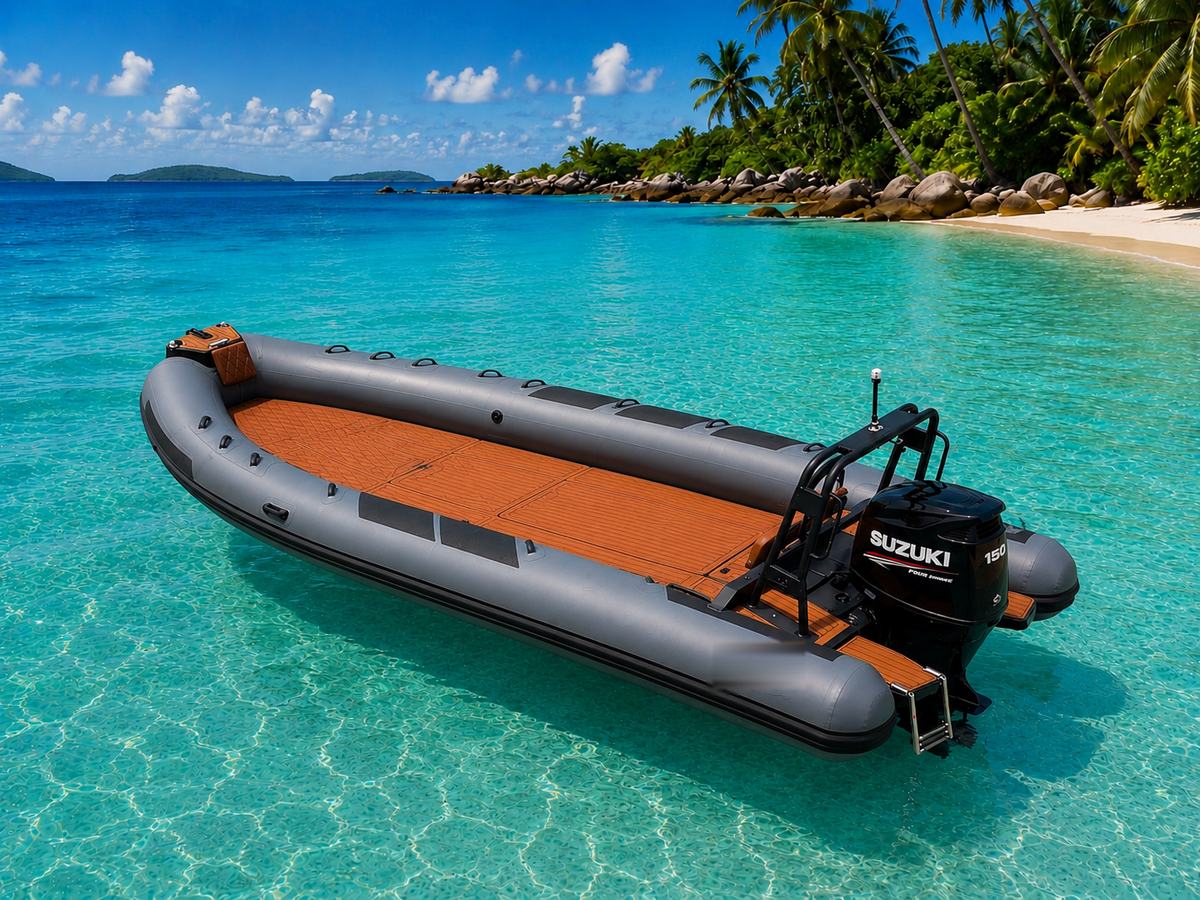
Same hull, same 5 mm 5083 plate, same double-plated keel — with everything taken out of it. No console, no helm seat, no windscreen. Just a flat teak deck from the bow to the transom and a tiller aft, so the helmsman sits on the tube out of everyone's way and the entire boat is usable.
That is exactly what a yacht needs and almost nothing on the market provides. Load a week's provisioning, six dive tanks, a folded paddle board and four guests without stacking anything on a seat. Land wet and drop your fins on teak. Come alongside on either quarter because there's no console to work around. Nothing on it can break at anchor in a swell, because there's nothing on it.
The tiller is Suzuki's own, not an aftermarket conversion. Throttle, shift, trim and tilt are all in the handle, the wiring is factory, and any Suzuki dealer in the Caribbean can service it without first working out what somebody bolted on. There is no cable run, no hydraulic circuit and no linkage between your hand and the engine — which on a boat that lives on a stern davit or a painter is the entire point.
The 115 planes with six aboard and it's the lightest boat we sell at 400 kg dry — the one worth measuring your davits against before you assume you have to tow it. And it tows and is towed on the same structural points as the rest of the range.
Length19' 0"
Beam8' 2"
Dry weight400 kg (hull)
PowerSuzuki DF115B
SteeringSuzuki factory tiller
Hull5 mm 5083 · double keel
DeckFull teak, flush, self-bailing
Passengers9
Cruise~25 mph
Top speed~37 mph
Hull speed under tow~5.5 kt
Tow pointsBow & stern, structural
Cruise and top speed are predicted from rigged displacement and the engine maker's published data, not measured. Sea-trial figures to follow.
Load Line 19
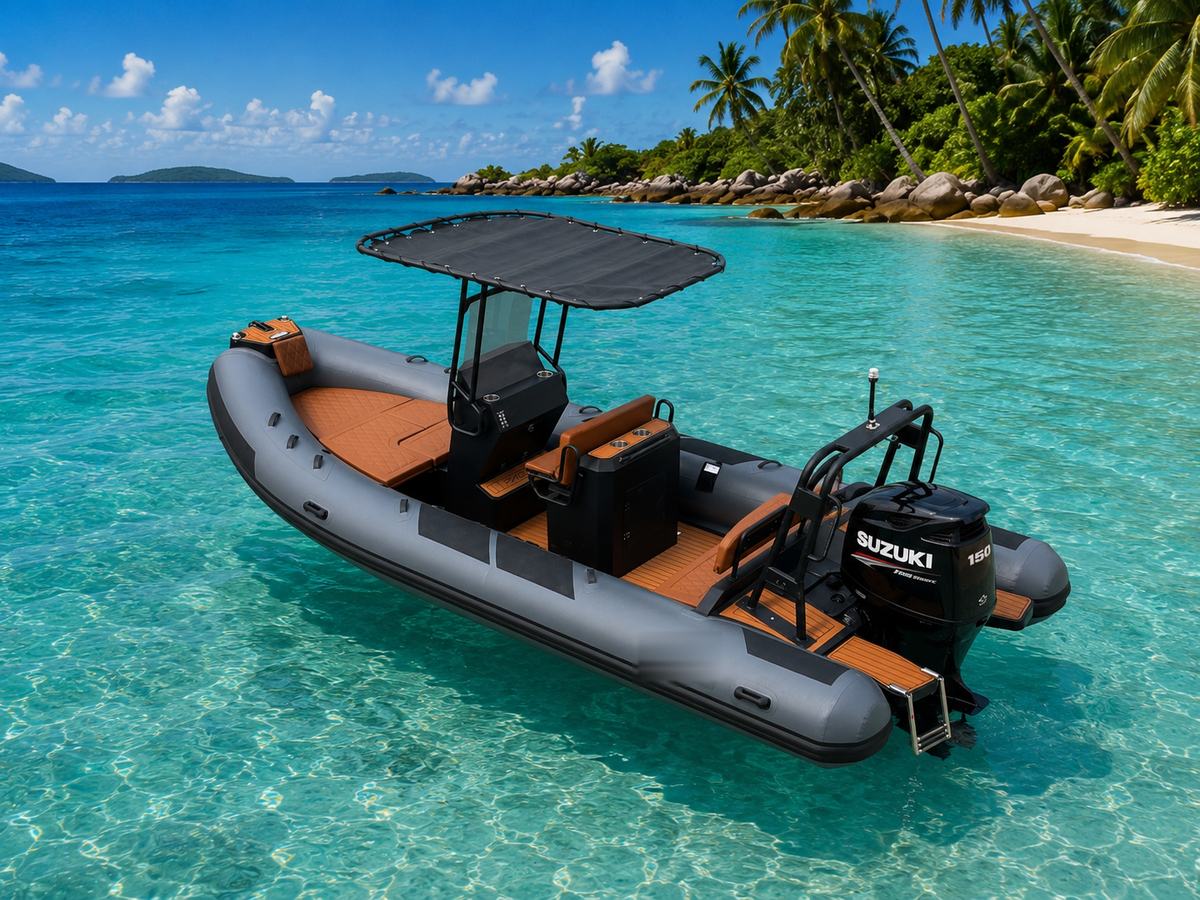
5.8 m · 9 passengers · Suzuki DF140B · 44 mph
$69,500rigged & commissioned
Delivered on island, engine hung, hydraulics bled, electronics flashed and sea-trialled. Grey tubes and brown leather as standard; other combinations to order.
Load Line 21
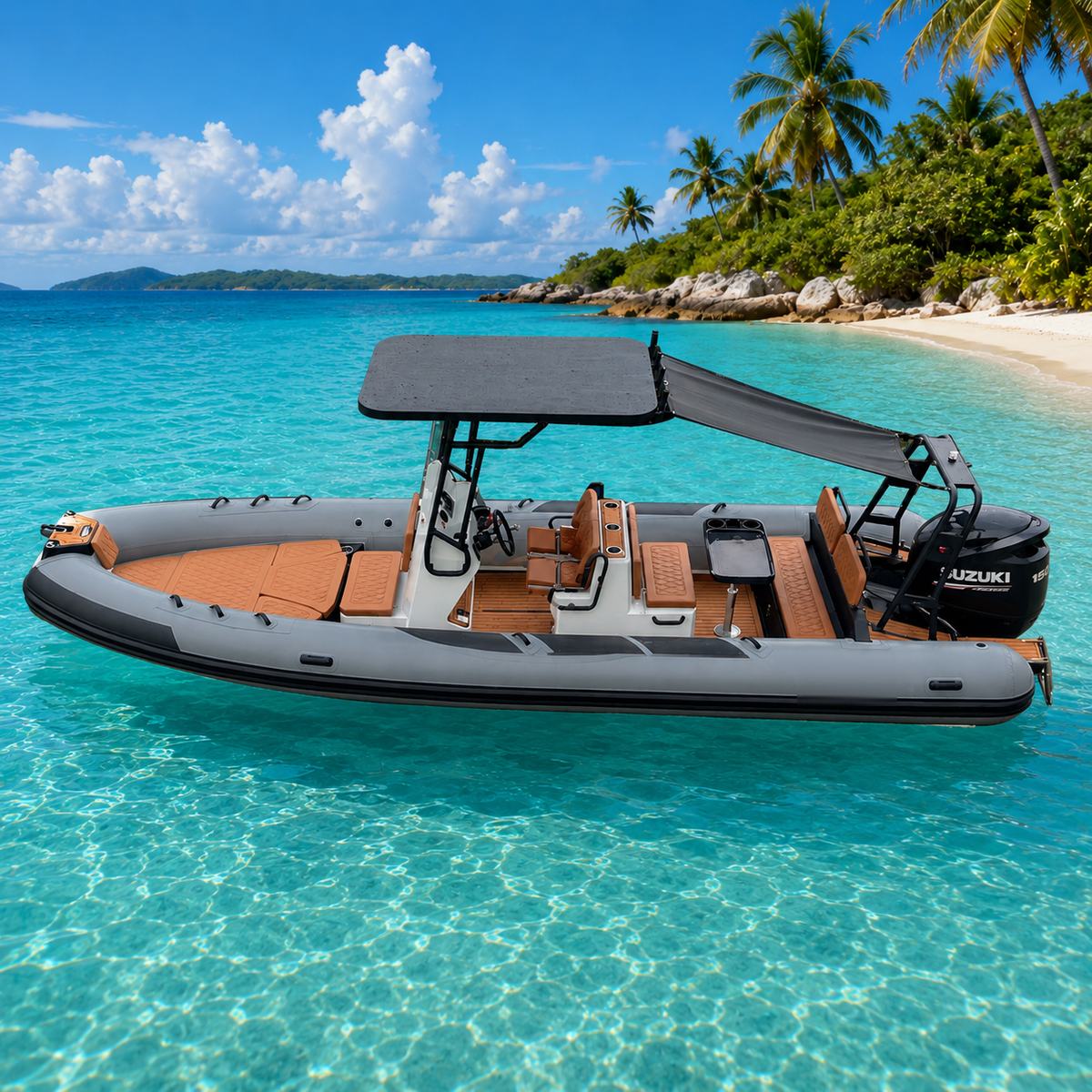
6.5 m · 9 passengers · Suzuki DF150 · 46 mph
$84,500rigged & commissioned
Same build, more waterline. Rated to 200 hp if you want it, though we'd talk you out of it for anything but offshore work.
Why we built a tender at all
Same philosophy as everything else we make: simplicity, durability, functionality. We wanted a tender for our own boat and found the market had answered a different question — not "what does a yacht actually need?" but "what is light enough to lift?"
Lifting is the problem
Craning or davitting a heavy tender onto deck twice a day is a daily chore, a crew injury waiting to happen, and a hydraulic system that will eventually fail on the one evening you needed it. Everything about the tender then gets designed backwards from that lift: smaller, lighter, less capable, and still the most disliked job on the boat.
So don't lift it
We think towing big beats lifting small. If the boat genuinely tows — structural bow post, a hull that tracks, a waterline long enough to keep up, a cockpit that self-bails on a wet passage — you never lift it, and you get to have a real boat instead of a compromise. That is the entire brief, and it is why the tow spec on these is structural rather than a fitting.
And when you truly must lift, take the 14. That is what it is for.
Why they're built this way
Designed to be towed
Most tenders survive being towed. These are built for it, and the reason is length. A hull under tow is a displacement hull, and a displacement hull has a speed it cannot exceed without climbing its own bow wave — roughly 1.34 × √LWL in feet. A 3-metre dinghy runs out at about 4 knots. The Load Line 19 makes about 5.5 knots, the 21 about 5.9.
That gap is the whole argument. Tow a small dinghy behind a yacht averaging 6.5 knots and you're dragging it 60% past its hull speed: it squats, throws a wall of water, yaws across the wake and takes half a knot off the mother ship all day. The same tow behind a Load Line 21 is 11% over — she's still in displacement trim, still tracking straight, still barely making a wave.
Length pays twice. The waterline gives the speed, and it also gives the directional stability: a longer hull on a painter follows instead of hunting, and doesn't try to surf up your transom in a following sea. The bow tow point is recessed into the stringer system so the load goes into structure rather than a fitting welded to a panel, and the cockpit is self-bailing, so a wet tow doesn't arrive full of water.
And to tow
The forward tow post is the piece that changes what this boat can do. It stands on the stringer system ahead of the console, which means the tender can take a line and pull astern — under full reverse thrust, with the load running into structure rather than into a cleat. That is how you actually move a yacht: back down on her, take the strain forward, and steer with the outboard. A stern-only tow point limits you to dragging something along behind. A front post lets a 19-foot tender warp a 60-foot boat off a dock, off a shoal, or onto a mooring in a crosswind. Order any of them with a high-thrust gearcase and the same boat becomes a yawl boat: lashed alongside the quarter, it pushes as well as it pulls, which is how you steer a yacht with no engine into a berth.
Designed for yachtsmen
Boats get designed for the person who signs the cheque. These were designed for the person who has to use them at six in the morning with a hangover and a guest list. Everything you touch is where your hand already is. Nothing you step on is slippery. There is no upholstery in a place that gets wet, no chrome that will weep down a white tube, and no gadget that fails at anchor and ruins someone's week.
It shows in what isn't there. No moulded liner hiding the wiring. No latches that seize. Nine aboard, a beam that lies alongside a passerelle without fenders, and a deck you can land wet fins and dive tanks on without apologising to anyone. If you have run tenders for a living, you already know what the second season does to a boat built for a boat show.
5083 is the alloy commercial and military aluminium hulls are built from, and it's the one that matters here: it holds its strength after welding and resists seawater and pitting in a way the general-purpose alloys don't. Plenty of aluminium boats are 5052 or 6061 because those are cheaper and easier to form. In this water, over ten seasons, you find out which one you bought.
The tow rings are the other detail worth understanding. They aren't D-rings welded to the topsides — they're recessed and tied straight into the stringer system, so a towing load goes into the boat's structure instead of into a weld on a panel. That's why we're willing to let a crewed yacht tow one across the Sound.
Deck & tubes
DeckingReal teak
TubesOrca Hypalon · 55 cm (50 on the 14)
UpholsteryBrown leather
ShadeT-top + aft canopy
SteeringHydraulic
ElectronicsRaymarine 9″ · VHF · fish finder
Real teak, not the foam that's printed to look like it. Foam decking is lighter and cheaper and it looks correct for about two seasons in this sun. Teak can be sanded, and in twenty years it will still be a deck.
Where that puts it
Load LineTypical import
Hull plate5 mm3–4 mm
Alloy50835052 / 6061
KeelDoubleSingle
Tow pointsStructuralSurface D-ring
Rated to towYesNo
Tow hull speed4.7–5.9 kt~4 kt
DeckTeakEVA foam
TubesHypalonPVC
A production leisure RIB is built to a price and a showroom. These are built to a duty cycle. If you're comparing on paper, compare plate thickness and what the tow eye is attached to — that's where the difference actually lives.
Hull only
Boat, steering and shade, no engine or electronics, EXW or FOB. For buyers with their own dealer relationship or a repower already in hand.
Two or more
Fleet pricing for resorts, villa groups, yacht management companies and dive operations. Same hull, same commissioning, better number.
Ex-charter
The 19s and 21 rotate out of the rental fleet on a fixed cycle with full service history, sold at a known discount. Ask what's coming out and when. The tiller boat is build-to-order only.
Delivery
Commissioned in St. Thomas and delivered anywhere in the USVI or BVI. Onward shipping quoted per destination — we clear our own imports, so the boat is not waiting on somebody else's broker.
Talk to us about a build
Lead time is roughly seven weeks from deposit plus six weeks on the water, so a boat ordered today lands about three months out. Tell us the boat and we'll send a written spec and a firm number.