01
Logistics, sourcing & provisions
Parts held on island, our own customs line out of Europe, China and the mainland, and delivery alongside — not to a counter.
Marine services · USVI & BVI
Logistics and provisioning, electrical system design, 3D scanning, inspection, tanks and enclosures, and glass nobody else will quote. For crewed charter yachts, cruisers and superyacht engineering departments.
Lauren L · USVI
01
Parts held on island, our own customs line out of Europe, China and the mainland, and delivery alongside — not to a counter.
02
Banks, charging, inversion and generation sized as one thing. 16 kWh modules that parallel to 200 and beyond.
03
Windows, bilge compartments, tanks and parts, dimensioned to a model that goes straight to our laser.
04
A 10 m borescope for the places a survey calls inaccessible, or twenty minutes on video before you fly anyone.
05
Scanned, cut, folded and built to enter through the opening you actually have.
06
Windscreens, deckhouse windows and hatch lenses for boats whose builder is long gone.
Why we're any good at it
Lauren L is a 27-metre luxury sloop that has completed a circumnavigation. That matters more than her length: she has been plugged into shore power on five continents, provisioned in places with no dealer and no chandlery, and asked to keep guests comfortable a very long way from anyone who could help. Every specification on this page has a reason, and most of those reasons happened somewhere between here and back again.
She is where we learned it, not the limit of it. We went looking for the parts to build her system and found the same thing you have: excellent equipment priced for superyachts, affordable equipment that fails in a bilge, and nobody in the Caribbean holding either.
Twenty-seven metres also happens to sit in the middle of the argument. Big enough to carry the systems a superyacht carries; small enough that the people aboard are the ones who fix them. We have had to satisfy both standards on the same boat, which is why we don't think they are actually different standards.
So we sourced it ourselves, built it, and now we sell it — in the order we built it, because that's the order it has to be done in. Batteries first. Everything downstream follows from the bank.
We're sailors of big boats. We know what a system has to survive, what breaks first, and what it costs when it goes down with guests aboard and a broker on the phone. That is a different qualification from reading a catalogue — and it is the same qualification whether the boat is sixty feet or a hundred and sixty.
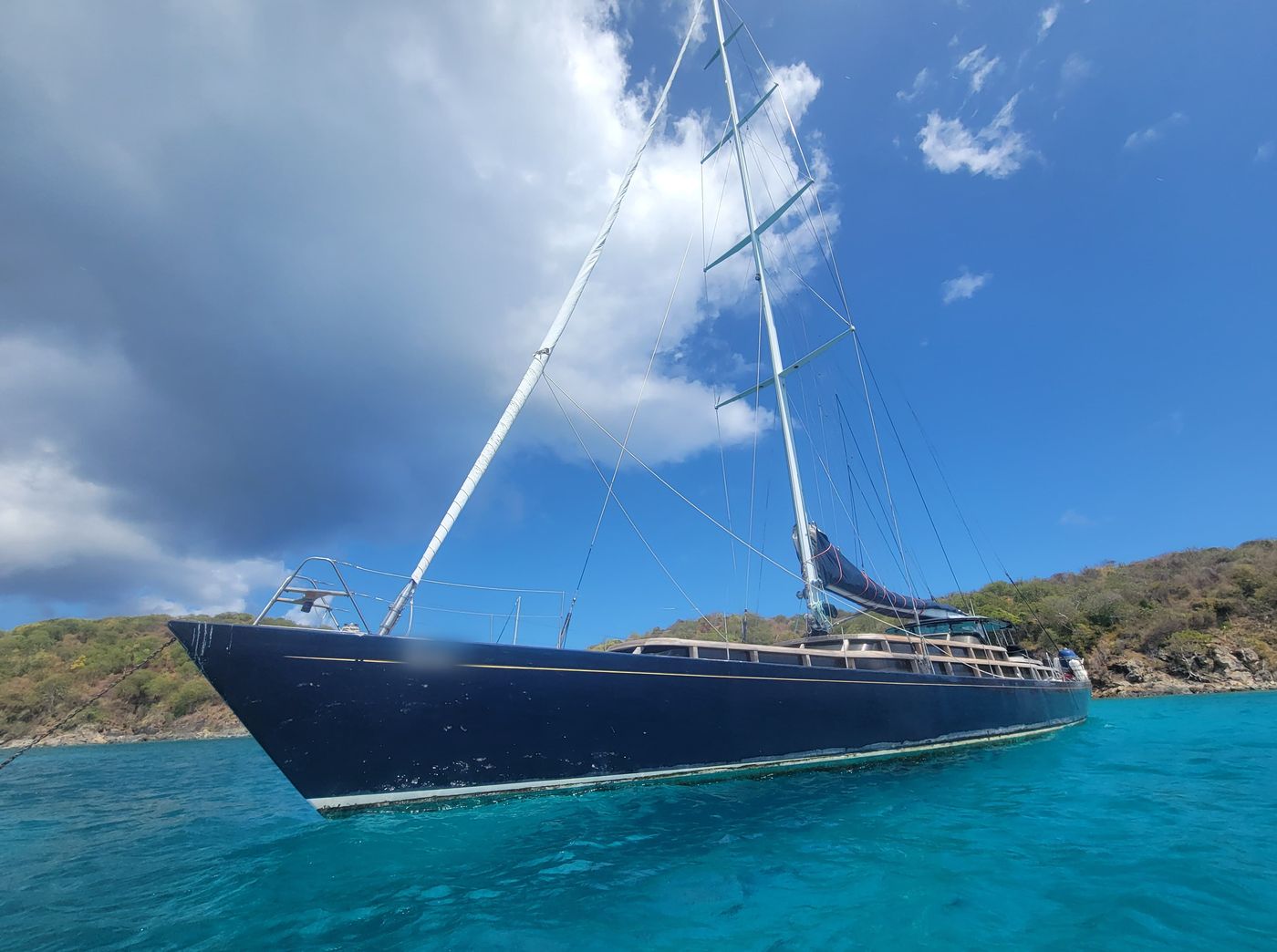
Cruisers and superyachts want exactly the same three things: simplicity, durability, functionality. A chief engineer on a 60-metre and a couple two thousand miles from a dealer are asking the identical question — will this work, will it keep working, and can it be fixed where it sits. What changes between them is scale, documentation and who holds the spanner. Not the standard.
Crewed charter yachts
Your system is revenue. A generator that has to run through the night at anchor is a review; one that fails in week two of a booked season is a refund and a reputation. We size for guest load, not owner load, and we specify for turnaround — the boat comes in Saturday and goes out Sunday, so nothing we fit can need a specialist to be flown in.
Silence at anchor is not a comfort feature on a charter boat. It is a thing brokers repeat.
Owner-operators and cruisers
You are the engineer, whether you wanted the job or not. Everything we sell is meant to be understood by the person who has to fix it at anchor — accessible, documented, standard parts, and monitoring you can read without a laptop and a dealer password.
This was our own problem first. It is still the version of the business we are most careful about.
Superyacht engineers & managers
You are not buying a story, you are buying a specification you can defend to a captain and a management company. Drawings, data sheets, load calculations, spares lists, service intervals and a named person who answers the phone. Modules parallel, so the architecture that works at 16 kWh works at 200.
And we are in your time zone, with your parts on a shelf forty minutes from your anchorage. That is usually the part that decides it.
Or skip it — send the boat, the loads and the deadline, and we'll tell you which of the three above you are and what it means for the spec.
01 · Logistics, sourcing & provisions
Ask anyone else in these islands for a part and the answer is Florida, four days, and a taxi to a dock. We hold stock here, clear our own imports, and run our own boats out of Compass Point — so it comes to where you are lying. Provisioning too: if we are already coming out to you, the run may as well carry everything else you need.
We design it with you
Send us your loads, your space and how you actually use the boat. We come back with a system — bank, charging, inversion, generation — sized as one thing, with the compromises named out loud. Off season, when there's time to argue about it.
We stock it here
Once the design is agreed, the parts come into the islands and sit on our shelf, not on a container ship you're tracking. We clear our own imports into the USVI and BVI, out of Europe, China and the mainland.
We deliver when you say go
At the dock, or on the anchor. We run our own boats out of Compass Point, so the gear comes to where the yacht is lying rather than to a warehouse counter for someone to collect. Same-day inside the East End when it's on the shelf.
If it's on the shelf
Provisioning
Guests landing Saturday and a galley to fill, or a passage to store for. We shop it, stage it and bring it out with the parts run — cold chain kept, nothing left on a dock in the sun waiting for a tender.
It is not glamorous and it is not expensive. It is four hours of a chief stew's day back.
Plan in the off season
The worst time to design a system is the week it fails, in season, with the boat earning. Agree it now, we stage the parts on island, and the install happens the day you say go.
We have owned Lauren L for more than a decade and taken her around the world. In that time we have bought, waited for, chased, returned and re-ordered very nearly everything a large yacht consumes, in most of the places it is difficult to do so — which is a slow and expensive education in who actually delivers and who merely takes the order.
Europe
A sister office, and the reason we can buy the European marine equipment that most Caribbean supply lines simply don't carry. It also gives us a second consolidation point: gear bought in the Med doesn't have to route through Florida to reach you.
China
Significant partners at the factory level, for volume production of designs we have already built and proven ourselves. That order matters: nothing goes to Asia until it has been drawn, cut, assembled and used here first. The specification is ours, the tooling is to our drawings, and so is the responsibility.
It is also the honest answer to why the equipment on this page is specified like superyacht gear and priced like it isn't. We are not badging somebody else's catalogue and adding a margin to it.
United States
Many years and the relationships that come with them: mainland distribution, warranty channels, and the freight lane into the USVI that we already run for our own fleet. Nothing about your delivery date depends on a broker we've never met.
It is also where we make things. We run our own custom manufacturing facility for precision laser cutting, bending and fabrication — which is the reason we can say yes when your battery compartment turns out to be an awkward shape.
Our own shop
Designed and prototyped in AmericaEverything we sell starts on a laser table in the United States. We draw it, cut it, fold it, build it, put it on a boat and find out what we got wrong — then do it again. Only once a design has actually proven itself does volume production go offshore, to our drawings and our specification.
Most of what makes an installation good or bad is metalwork nobody photographs: the enclosure, the bracket, the mount, the plate that carries a load into the structure instead of into a bulkhead. Buying that in is slow, expensive and usually wrong by ten millimetres. We cut and fold our own.
What it means for you
Why it changes the answer
A supplier without a shop has to fit your boat to their box. We fit the box to your boat. That is the whole difference between a system that goes in cleanly and one that costs a week of yard labour and still ends up in the wrong locker.
And the shop is open to work that has nothing to do with power systems. Tank tops, engine beds, davit and crane mounts, arch and radar work, chainplate backing, custom brackets, one-off plate. If it is stainless or aluminium and it needs to be right, we will quote it.
Send us a photograph with a tape measure in it and we will tell you what will fit. Send us a drawing and we will make it.
When you call about a part, somewhere in that chain the working day has already started. A question asked in St. Thomas in the afternoon is being answered in China overnight and quoted in Europe before you have had breakfast. It is the least glamorous advantage we have and the one that most often gets a boat moving again.
02 · Electrical system design
You can buy any one of these from us. We would rather quote the chain, because the failures we get called out to are almost always the seams between them. And the chain is shorter than people expect: on most boats the switch to lithium is a bank, a charger and an inverter. Your generator stays where it is. Everything we build to that chain shares one standard — stainless, IP67, sealed — so the system goes where the space is rather than where it happens to be dry.
01 · Where it starts
You can actually put it in a bilge
That sentence is the specification. Most lithium marine batteries are a plastic box with a BMS inside and a warranty that quietly assumes a dry engine room — which is why they end up in the one dry locker you wanted for something else. Ours is a 316 stainless IP67 enclosure with integrated fire suppression. It goes where the space is.
And the space is whatever shape your boat gives you. We build custom enclosures — around a stringer, under a settee, split either side of a shaft log, long and shallow instead of tall and square. Nobody's battery compartment is a rectangle, and asking an owner to find room for one is how good systems get value-engineered down to a bad one. We cut and fold them in our own US facility, so “we can make that shape” is a fact rather than a hope.
The BMS is internal and the monitoring display is remote, so the battery can live somewhere you'd rather not crawl while you read its state of charge from the nav station. Charge control is Victron-compatible — it drops into the ecosystem your boat is probably already running.
02 · Putting it back in
Keep your generator. Change the charger.
The usual objection to going lithium is that the genset has to go too. It doesn't. We size the charger to load your existing generator to about 80% — which is where a diesel wants to live anyway. It stops wet-stacking, it puts real energy into the bank, and it shuts down. The generator you already own becomes the right generator, because the load finally matches the machine.
That works because of the input side: variable voltage and variable frequency. This is the specification a circumnavigation writes for you. The charger does not care where you plugged in or what you plugged into. 120 at 60 hertz in Florida. 230 at 50 in the Med. Three-phase off a commercial quay. Or the output of a tired genset that a fixed-input charger simply refuses.
A big bank is only as useful as your ability to refill it. At 20 kW you put a serious charge back into the boat in the time it takes to have lunch.
Same enclosure standard as the battery: stainless and IP67, in air cooled or water cooled. We default to air cooled, because a 20 kW charger has real heat to shed and the usual answer is a raw-water loop — a pump, a strainer, a heat exchanger and four more things to service in a place you can't reach. Sealed and air cooled, it goes in the same kind of space the battery does and you never think about it again.
Water cooled is there for the boats where air isn't enough: a hot, closed engine room with nowhere to dump heat, or an installation where you need the power density more than you need the simplicity. It's a real trade rather than an upgrade, and we'll tell you which side of it your boat is on.
03 · Getting it out
48,000 BTU of air conditioning starts on it
That is the number worth knowing, because it is the one every other spec is really about. Four tons of cooling is roughly 4.6 kW running, and the moment that matters is the compressor start — staggered across units, the peak lands somewhere near 9 kW. Our inverters are sized for that, not just for the running load, which is where most installations quietly fail. A 50 gph watermaker starts on it too.
Split phase, because an American boat has 240-volt loads and a single-phase inverter leaves you choosing which ones you can run. Solar charge controllers built in, because a separate MPPT is another box, another set of cables, another thing to fuse and another thing to fail. And priced so the inverter isn't the line item that kills the refit — the gap between a system you specify and a system you actually build is usually this one.
Which is the whole point of the exercise. Air conditioning all night, at anchor, with the generator off. Not a quiet generator — no generator. Everyone aboard sleeps, and in the morning the charger puts it back in the time it takes to have breakfast.
04 · Only if you need one
Not a prerequisite — an option
Read the charger section first: in most refits the generator you have is fine, and the charger is what changes. This is for the boats where it isn't — a new build, a genset at the end of its life, or a bank so large that the existing machine can't fill it in a reasonable window.
When that's the case, we size it against the bank and the charger as one calculation rather than against the air conditioning. It runs hard for a short time, puts real energy into the boat, and stops. Less fuel, less running time, less noise, and a great deal less of you thinking about it.
Scaling
The architecture doesn't change. The count does.Modules parallel. A 16 kWh bank and a 200 kWh bank are the same system with a different bill of materials, the same monitoring, the same charge profile and the same spares. Nothing about a large boat requires a different philosophy — it requires more of the same units and a properly done bus.
Indicative only. We size against measured loads, duty cycle and the boat's existing generation before quoting anything.Typical shape
At the larger end the interesting question stops being capacity and becomes redundancy: split banks on separate busses so a single fault never takes the hotel load with it. We design it that way as a matter of course above about 100 kWh.
None of the above is worth much to a chief engineer without the paperwork behind it. This is the part of the offer we would want to see if we were the ones signing off.
Before
During
After
03–06 · Measure and make
Past about twenty years old a boat stops having a parts catalogue. The yard is gone, the mould is gone, and the drawing was never issued. We carry a 10 m inspection camera and a 3D scanner, and we own the laser and the folder at the other end. One loop, one supplier.
03
Windows, bilge compartments, tanks, parts
We scan the space, not the sketch. A window aperture that has been faired twice, a bilge compartment with a stringer through it, a tank you can only measure by feel, a part you can only supply broken — scanned to a model, and the replacement cut from that model rather than from a tape measure and an optimistic assumption.
The scan is the whole trick. It goes straight to a cut file on our own laser, so nobody re-draws it by hand and nobody discovers the problem at the fitting-out stage.
04
A 10 m snake camera, or twenty minutes on video
Our borescope reaches ten metres, which covers most of the places a survey report says "not accessible": inside a tank without cutting it open, behind a liner, down a void, along an exhaust run, into a bilge nobody has seen since the boat was built. You get the footage, not just an opinion about it.
And where a body on the boat isn't needed, we do it remotely. Book a slot, walk the boat with a phone, and we work the problem live — what it is, what it costs, what to order, and whether it waits for the yard. Honest about the limit: some things need hands, and we'll tell you within ten minutes if yours is one of them.
05
Scan it, cut it, fold it, fit it
A failed tank on an older boat is usually a bigger problem than the tank: the compartment was built around it, nothing off the shelf is that shape, and the yard's answer is to cut something. We scan the space, model a tank that goes in through the opening that actually exists, and cut and fold it ourselves.
Same process, same shop, for battery enclosures, engine beds, brackets, mounts and plate work. The scan is what makes it a one-visit job.
06
The part nobody will quote you
Ask around for a curved, laminated windscreen for a boat that stopped being built in 1998 and you will mostly be told no. It is the single hardest thing to replace on an older yacht: the aperture has moved, the original template is gone, and the few people who can make it want a pattern you cannot produce without destroying the one you have.
We scan the aperture, build the model, and have the glass made to it — laminated, curved, tinted or coated as required — or cut it in Lexan where impact resistance, weight or lead time matter more than optical perfection. Pilothouse and windscreen glass, saloon and deckhouse windows, hatch lenses, storm covers, and one-off panels that were never standard to begin with.
Watermakers as a service
Energy recovery exists to solve a problem you no longer have. It was the right answer when a cruising boat had 400 amp-hours of lead and no way to refill it — a Clark pump and a 48-volt system bought water out of almost nothing. Build the power system first and that constraint disappears, and what's left is a complicated, proprietary machine making water slowly.
The trade, honestly
50 gallons an hour off your inverterThe simple unit costs you 2.7 kWh more to make the same fifty gallons. That is 17% of one 16 kWh module — and you get the water in a third of the time, from a machine with no proprietary parts in it. If you are running the genset to charge anyway, it costs you nothing at all: the water is made inside a charge cycle you were already having.
Where it really shows
A boat with guests aboardTwelve people at thirty gallons a head is 360 gallons a day. The simple unit does that in a little over seven hours. The recovery unit needs twenty-two — it never stops, and it still doesn't keep up.
That is the actual failure mode. Not energy. A machine specified for a couple crossing an ocean, asked to provision a charter, running continuously, with a Clark pump that wanted servicing two months ago and a rebuild kit that is in California.
Standard membranes. Standard prefilters. A pump you can get anywhere. Water in an hour.
And when you'd rather not own one
Rental and delivery110-volt rental watermakers. Yours is down, or you never had one, or you have guests for two weeks and a tank that won't cover it. A unit goes aboard, runs off what you already have, and comes back when you're finished. No install, no through-hulls, no capital decision made under pressure.
Boat-side water delivery. When the answer is simply that you need water today, we bring it to you at anchor. It is the least sophisticated service we offer and some months it is the one people are most grateful for.
Figures above are working estimates for a typical seawater unit — we size against your real feed temperature, salinity and duty before quoting.Also
We run Suzukis across our own fleet, in salt, eight months a year. Scheduled service, diagnosis, and repowers specified and rigged properly — controls, cables, gauges and props, not just a lump on the transom. Impellers, anodes, filters and pumps on the shelf rather than ordered the day you need them.
Next step
Loads, space, how you cruise, and when you're next out of the water. We come back with a system, what's already on island, what has to come in, and a real date. No survey fee for a straightforward job.
Fastest
CallIf a boat is stopped, don't fill in a form. +1 (917) 312-4360. Somewhere in Europe, China or the US the working day has already started.
Diagnosing
Book twenty minutes on videoWalk the boat with a phone and we'll work the problem with you — what it is, what it costs, and whether it can wait for the yard.
Planning
Use the off seasonSend loads, space and your next yard window. Drawings and a spec pack come back before anyone asks you for money.
systems@eastendtenders.com · +1 (917) 312-4360 · VHF 16 · Compass Point, St. Thomas USVI
Checkout